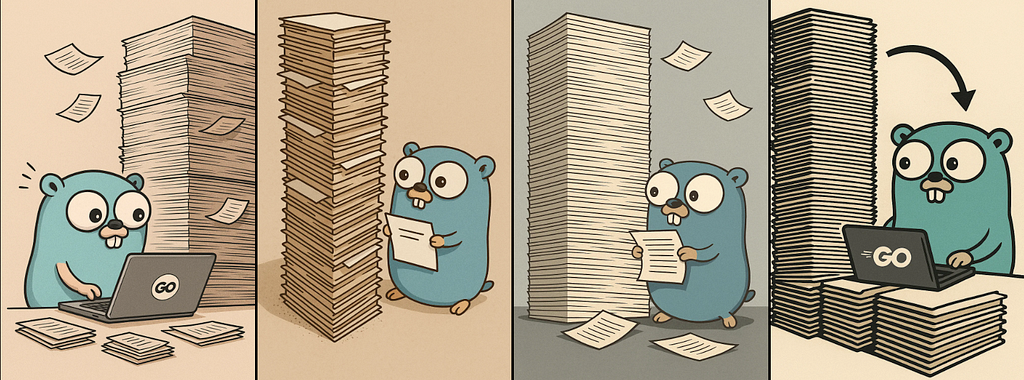
Why Golang is a good choice for very huge files?
- Efficient Memory Usage : Go allows reading files in chunks (e.g., using bufio or io.Reader) so you don’t have to load everything into RAM.
- Concurrency Support : Goroutines and channels let you process parts of the file in parallel, speeding up tasks like filtering, transformation, or computation.
- Strong Standard Library : The os, io, bufio, and encoding packages provide tools to process files efficiently.
- Static Typing & Performance : Faster and safer than scripting languages for processing large volumes of data.
Sample project
As developers, we often face the challenge of processing very large files without consuming too much memory or CPU—because fewer resources means lower costs 🤑. In this post, I’ll show you how to handle huge files efficiently in Go, line by line, using concurrency and memory reuse.
Project Structure
| |
Model
The model.go defines reusable data structures (Payload and Chunk) and uses sync.Pool to efficiently manage their memory, minimizing allocations and garbage collection when processing large amounts of data.
| |
Processor
The processor.go reads a large file using buffered scanning, groups lines into chunks, and processes them concurrently using a worker pool. It leverages buffered channels and memory pools to efficiently manage data flow and minimize allocations, making it ideal for fast, low-overhead processing of large files.
| |
Main
The main.go is a simple command-line interface that accepts user parameters, opens the specified file, and runs the processing logic with those settings. After processing, it outputs useful information about the process, such as execution time and memory usage, to help monitor performance during large file handling.
| |
CLI-supported parameters:
| |
Example Usage:
| |
You will get a similar output depending on your file and computer.

Bonus point: Generate sample data
It includes a handy simple Bash script (generate.sh) that quickly creates realistic sample data in CSV format, perfect for testing and demonstration.
| |
| |
| |
And when we run it we have a similar output:

NOTE : Depending on the number of rows and the power of the computer, this script can take a long time.
Conclusion
Processing huge files in Go doesn’t have to be hard. Using Go’s concurrency and memory reuse features, you can handle big CSVs or text files efficiently without using too much memory. This makes your programs faster and more reliable, especially when dealing with large datasets
Repository
The code for this tutorial can be found in the public: GitHub - albertcolom/go-file-processor
You can read the article on Medium